You send 1,000 satisfaction surveys. 80 people respond. You call that data. Meanwhile, your AI chatbot handles hundreds of conversations a day and captures zero structured feedback from any of them.
That's the CSAT paradox: the channel with the most customer interactions is the one with the least satisfaction measurement. What if every AI chatbot conversation automatically contributed to your satisfaction score — without a single survey email?
Why Traditional CSAT Collection Is Broken
The Customer Satisfaction Score (CSAT) is supposed to be your most direct signal of how customers feel. The formula is straightforward: (Satisfied responses / Total responses) x 100. But the way most businesses collect it has fundamental problems.
The result is a CSAT score that looks precise (82.4%) but is actually based on a tiny, biased sample. You're making decisions about product quality and support staffing from data that represents less than 10% of your customers.
A CSAT score based on 80 out of 1,000 customers isn't a measurement — it's a guess with a decimal point.
The Alternative: Conversation-Native CSAT
What if satisfaction measurement happened inside the interaction instead of after it? That's what conversation-native CSAT does. Instead of sending a separate survey, the feedback mechanism is embedded directly in the chat experience.
The difference isn't just speed. It's coverage. When the feedback prompt appears at the natural end of a conversation, response rates jump dramatically — because the visitor is already engaged and the effort is minimal.
How AI Chatbots Collect CSAT Automatically
A well-designed AI chatbot captures satisfaction data at three levels — each providing a different depth of insight.
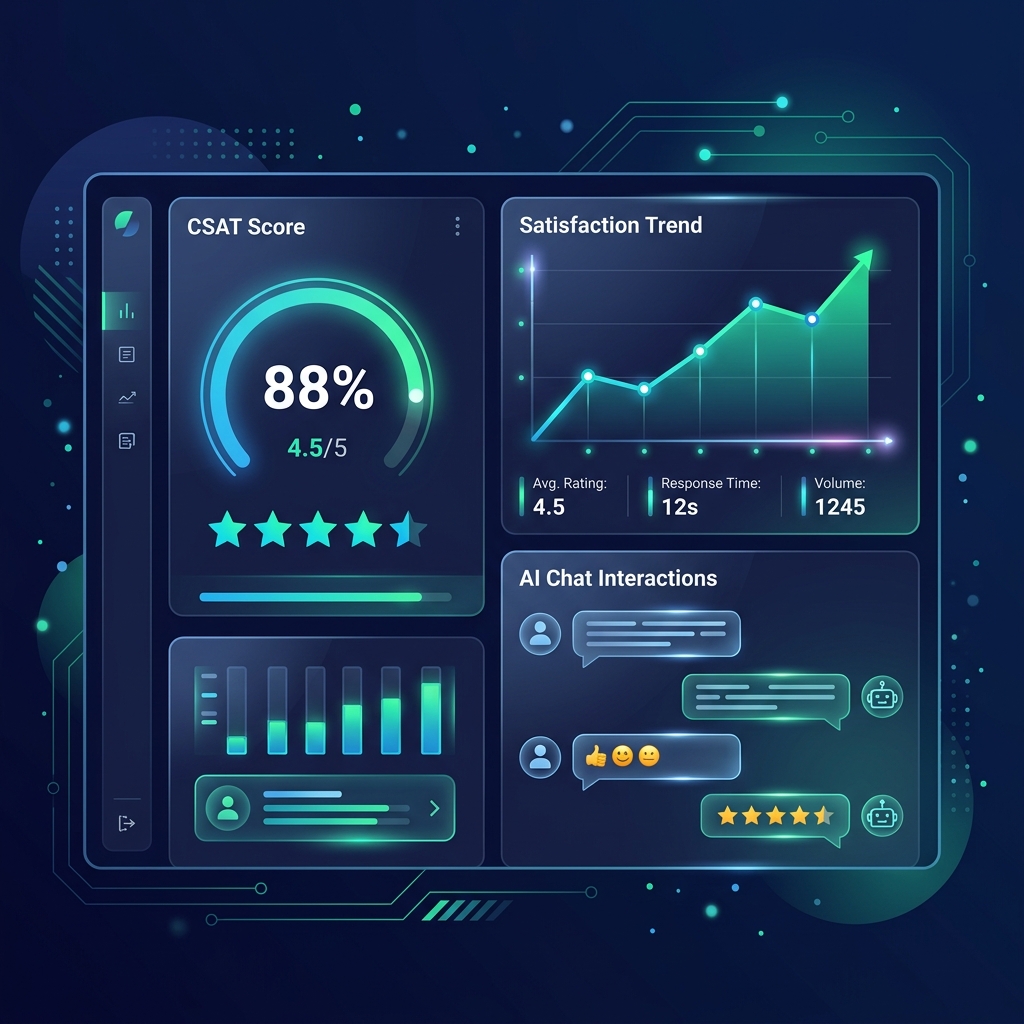
Beyond Star Ratings: Reading Satisfaction from Conversation Tone
Star ratings and thumbs feedback are explicit signals — the visitor deliberately clicks something. But most conversations end without any explicit feedback at all. Does that mean you have no data? Not if you know where to look.
The conversation text itself is full of implicit satisfaction signals that AI can detect and score automatically.
By analyzing these signals, AI can assign an inferred satisfaction score to every conversation — even the ones where the visitor never clicked a star. This turns CSAT coverage from roughly 10% of conversations (those with explicit ratings) to nearly 100%.
The explicit rating always takes priority when available. But for the majority of conversations where no rating is left, inferred satisfaction fills the gap with a surprisingly reliable signal.
The CSAT Formula — Applied to AI Conversations
The standard CSAT formula is simple:
CSAT = (Number of satisfied responses / Total responses) x 100
In AI chatbot context, "satisfied" typically means a rating of 4 or 5 out of 5 stars. If 200 visitors rated their experience and 164 gave 4+ stars, your CSAT is 82%.
Want to calculate your own score? Use our free CSAT Calculator to see how your numbers compare to industry benchmarks.
Real-Time Dashboards vs Quarterly Reports
Traditional CSAT lives in quarterly PDF reports that arrive weeks after the data was collected. Conversation-native CSAT lives in a real-time dashboard that updates with every interaction.
A good CSAT dashboard shows:
| Metric | What It Tells You | Action |
|---|---|---|
| Daily CSAT trend | Is satisfaction improving or declining? | Spot problems before they become patterns |
| Score distribution | How ratings spread across 1-5 stars | Identify if you have a "polarized" audience |
| 7d / 30d / 90d averages | Short, medium, and long-term trends | Separate blips from real shifts |
| Thumbs down hotspots | Which AI answers are failing | Fix specific knowledge gaps |
| Comment analysis | Why visitors are dissatisfied (in their words) | Prioritize improvements by impact |
This is the difference between reporting and intelligence. A quarterly report tells you what happened. A real-time dashboard tells you what's happening — and what to do about it.
The Feedback Loop: CSAT to Knowledge Gaps to Improvement
The most powerful thing about conversation-native CSAT isn't the score itself — it's the feedback loop it creates.
This is the same principle behind the Knowledge Health Score— your AI is only as good as the data it was trained on. CSAT tells you where the data is failing. The health score tells you what to fix. Together, they create a continuous improvement engine.
CSAT without action is just a number. CSAT connected to knowledge gaps becomes a roadmap for making your AI smarter every week.
How Much Does CSAT Cost on Other Platforms?
Here's something most businesses don't realize until they're deep into a vendor contract: CSAT measurement is often a paid add-on, not a standard feature.
| Platform | CSAT Survey Cost | How It Works |
|---|---|---|
| Intercom | $99/month add-on | Requires "Proactive Support Plus" add-on. 500 survey sends/month cap, overage charges apply. On top of $29-$132/seat/month + $0.99/AI resolution. |
| Zendesk | Included from $55/agent/month | CSAT surveys included in Suite plans, but Suite starts at $55/agent/month (annual). Per-seat pricing adds up fast. |
| Freshdesk | Included from $49/agent/month | CSAT available on Pro plan and above. Lower tiers don't include it. |
| Dedicated survey tools | $25-$100+/month | SurveyMonkey, Typeform, etc. require separate integration, separate billing, and separate data silos. |
| AI chatbots with built-in CSAT | Included | Satisfaction data collected automatically from conversations. No add-on, no per-seat charges, no survey limits. |
The pattern is clear: traditional platforms treat CSAT as a premium feature or require expensive per-seat plans to access it. Compare costs in detail with our Intercom Pricing Calculator or Zendesk Pricing Calculator.
CSAT Benchmarks: What's Good for AI Chatbots?
CSAT benchmarks vary by industry, but AI chatbot interactions have their own expectations. Most businesses aim for 80%+ CSAT on AI-handled conversations.
| Score Range | Rating | What It Means |
|---|---|---|
| 90-100% | Excellent | Your AI is well-trained and answering accurately. Maintain and optimize. |
| 80-89% | Good | Solid performance. Look for specific topics with lower scores to improve. |
| 70-79% | Needs work | Significant knowledge gaps or accuracy issues. Review thumbs-down patterns. |
| Below 70% | Critical | Your AI may be hurting more than helping. Audit your knowledge base immediately. |
CSAT is just one dimension of AI quality. A more complete picture comes from a composite quality score that blends satisfaction with confidence (did the AI find relevant sources?) and resolution (did the conversation end successfully?). This is the approach behind the AI Quality Score used in modern chatbot analytics.
For related metrics, see how to calculate your Net Promoter Score (NPS) — which measures loyalty rather than satisfaction — or your Customer Effort Score (CES) — which measures how easy the interaction was.
What This Means for Your Business
The shift from survey-based CSAT to conversation-native CSAT changes three things fundamentally:
This pairs with Visitor Intelligence — while CSAT tells you how satisfied visitors are, visitor intelligence tells you who they are and how they found you. Together, they give you the complete picture: which types of visitors are most satisfied, which traffic sources drive the best experiences, and where to focus your improvement efforts.